
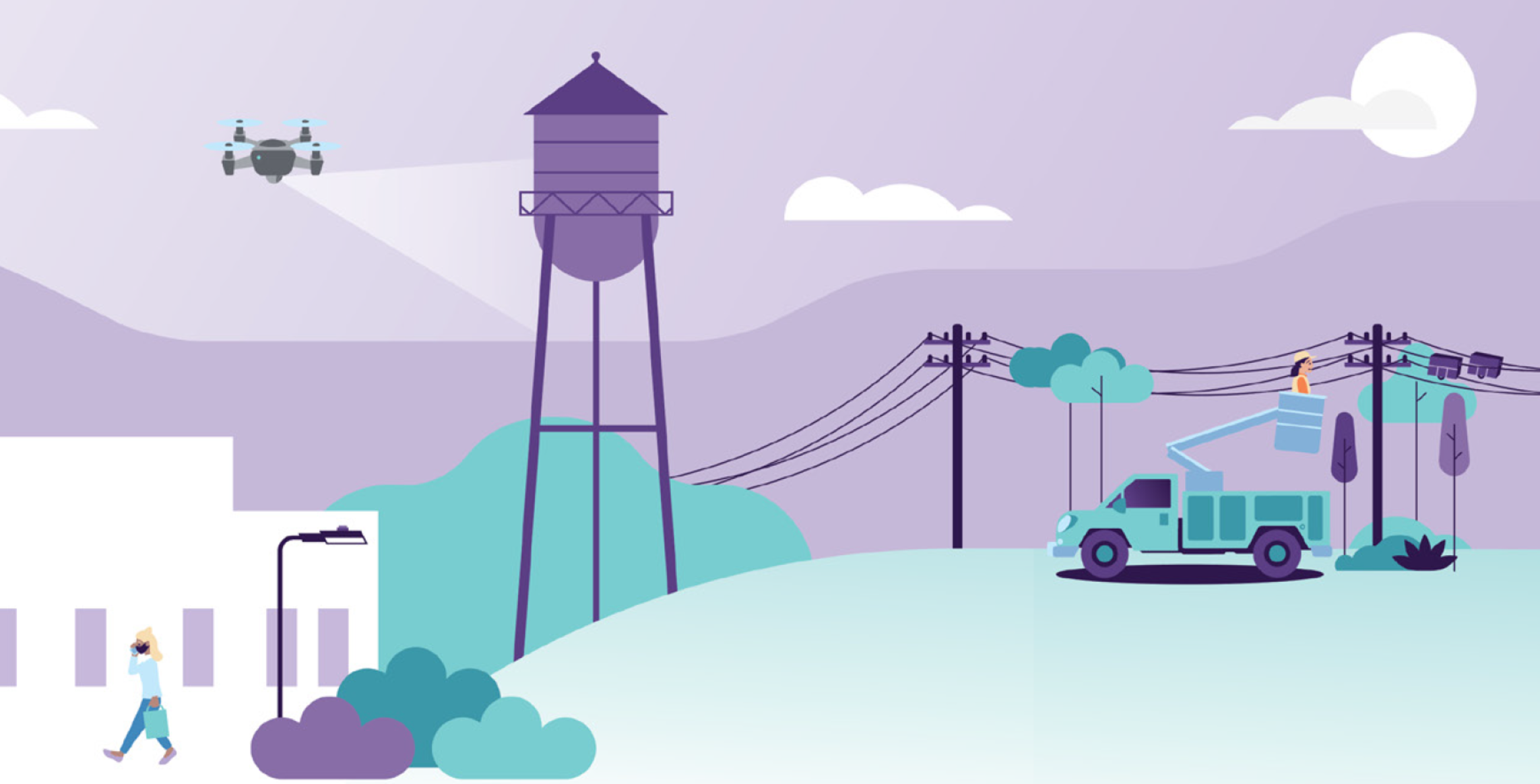
CTIA and Ericsson: Possibilities, partnerships, and more for wireless networks and smart utilities
Electric, gas, and water utilities are under increasing pressure to operate more safely, efficiently, and cost-effectively. To meet these challenges, utilities are turning to advanced smart-grid technology, which comes with its own challenges.
How do utilities make sure networks are reliable and fast enough to send much needed data to employees in the field and enable them to communicate in an emergency situation? Are new devices for monitoring and maintenance interoperable with the rest of the grid?
“With more smart grids and sensors on a network, it’s important to be able to manage these new complexities,” says Ericsson North America VP and CTO Business Development, Elisiario Cunha Neto.
Utilities are looking to harness wireless connectivity to build more reliable, secure, and flexible digital infrastructures—and are at different stages in this journey.
“Some are really mature and pushing the industry forward,” Elisiario Cunha says. “Others are working on RFPs and RFIs to understand what it is needed to build their own private networks.”
Showing what’s possible
The Ericsson Utilities Innovation Center is designed with these questions and more in mind, showcasing how wireless networks can support an ecosystem of industry-specific use cases and devices.
Elisiario Cunha calls it “a sandbox for innovation” where Ericsson, its customers, and its partners can develop and try new use cases, then measure improvements in security, resilience, and efficiency.
At a facility in Plano, Texas, a private LTE network supports a growing array of real-world utility applications. For example:
Sensors embedded onto distribution poles automatically detect a tilt, fall, or downed power line.
A cellular-connected video camera uses AI software to process video in real time, flagging abnormal activities related to a switchgear fault or power arc and sending out an automated alarm.
Researchers explore the potential of microwave connectivity for teleprotection—monitoring the condition of the grid so that faulty parts can be isolated and disconnected.
“It’s very important to have an environment to show the use case,” Elisiario Cunha says. “Ericsson Utilities Innovation Center is a purpose-built fully operating lab that creates an environment for solving utilities’ real-world problems.”
Taking the next step
Utilities also need clear requirements for delivering solutions, “showing not only the why but how to deploy their networks to address different use cases,” Elisiario Cunha says.
To this end, Ericsson is working with CTIA on a reference guide, scheduled for release in the second half of 2023.
The guide’s focus: using cellular networks for connected utility deployments to address electric, water, and gas challenges, including adoption of future technologies.
With the advent of cost-effective, private 4G and 5G networks, a utility can now build and manage a single network that covers the requirements of the vast majority of their operational telecom (O/T) needs. Such a network reduces complexity and operational expense while increasing throughput, security, and reliability—and reducing latency.
The CTIA/Ericsson reference guide will explore engineering considerations, maintenance implications, and the results and dependencies utilities have seen so far. Use cases will be supported by best practices, frameworks, and certification standards.
Working together toward an end-to-end ecosystem
Ericsson Utilities Innovation Center’s facility in Texas plays another vital role in bringing wireless-enabled utility solutions to life, Cunha Neto explains. Here Ericsson tests and validates 4G and 5G devices and applications to ensure devices are certified for operation on the network in the industry standards for conformance to 3GPP, performance testing and cybersecurity.
“Security is vital for utilities,” he says. “This is critical infrastructure, so it’s important to always keep in mind that these are mission-critical networks.”
Just as cybersecurity standards, spectrum, devices, chipsets, radio networks, and network management need to work together across an end-to-end ecosystem, utilities, wireless providers, and technology companies must work together to build this ecosystem, Elisiario Cunha says.
Ericsson is committed to such collaboration, he explains. In addition to its partnership with CTIA, the company is a member of the Utility Broadband Alliance (UBBA), another organization collaborating to advance private networks. Ericsson is also among the vendors contributing to the Third-Generation Partnership Project (3GPP), a global initiative developing specifications and standards for cellular communications technologies.
“Utilities Innovation Center advances Ericsson’s position in the Utilities segment, demonstrating true thought leadership to our customers, promoting the ecosystem, and enabling end-to-end use cases that show how Private LTE and 5G can deliver concrete impacts for power infrastructure in terms of security, resilience and efficiency.” says Elisiario Cunha.